
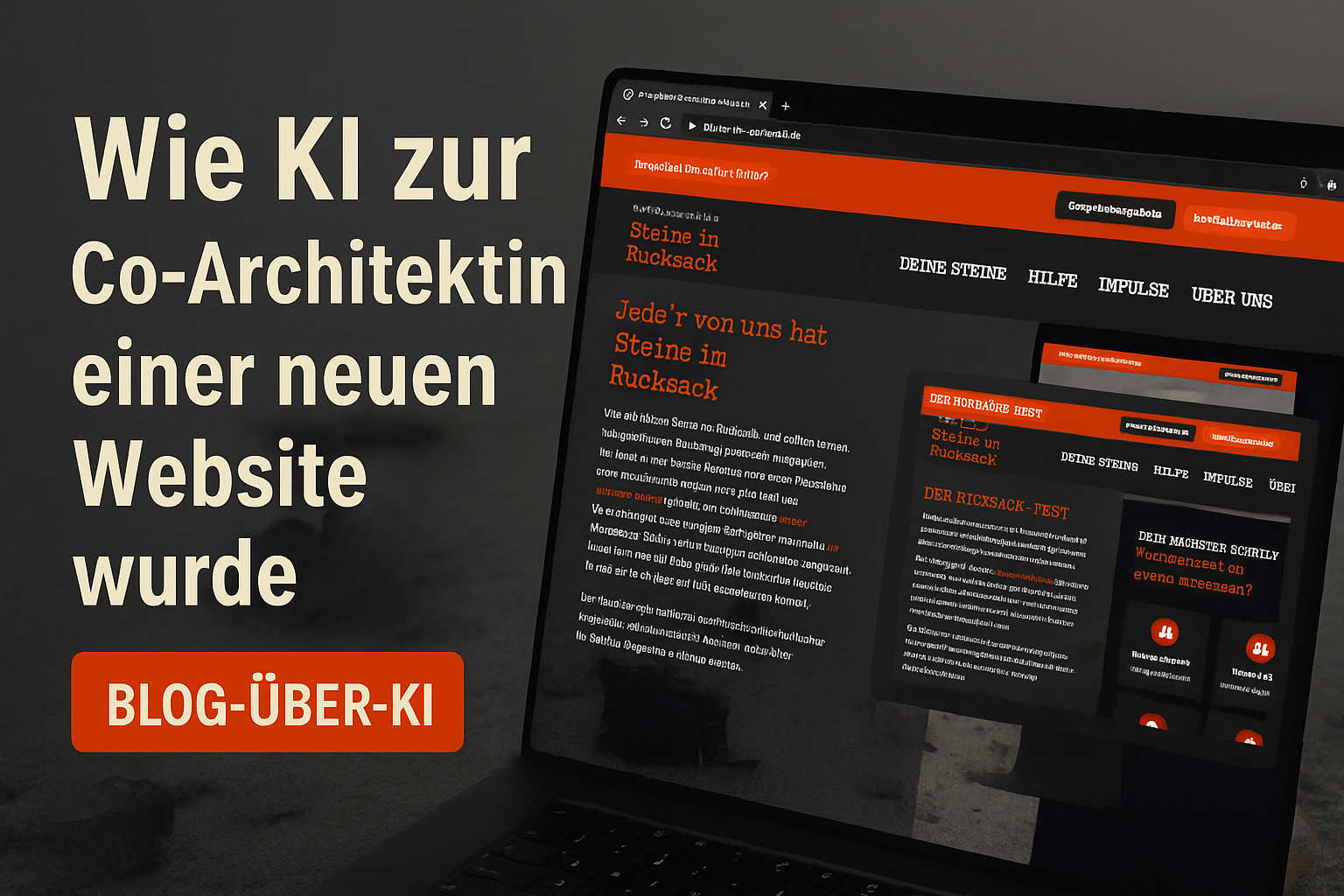
AI can do a lot these days. If you use it correctly. Over the last few weeks, I have created a completely new website together with ChatGPT. Conceived, structured, designed, technically implemented and SEO-optimized. And invented a self-test that could help people to find initial offers of help directly and accurately via AI in mental health crises in the future.
Honestly, I'm thrilled. But none of this came about because I sent off a single super prompt and then a finished website tumbled out, but because I tinkered over and over again for hours, days and weeks. Again and again I sat there with ChatGPT as if with a hard-working and incredibly competent employee, contributing, discussing and refining my ideas and getting help where I needed it.
From the idea to the self-test
Incidentally, the decisive impetus came from the AI itself. At least somehow. At some point, I just sat down and asked ChatGPT if he could see a way to make the rucksack model, which I use to try and make the causes of depression tangible, more accessible to the world. His suggestion surprised me: why not develop a self-test that makes the rucksack model an interactive experience?
OK, I said. Then go ahead. And ChatGPT has generated the complete calculation logic, the code and the evaluation structure. Some of it was still pretty shirt-sleeved. But as a basis that you could really do something with.
I then adapted the questions, texts and weightings so that they matched the content of the model and really added value. In the end, this resulted in a Test This tool assesses the current and long-term situation of people in mental health crises and then provides feedback based on four factors: physical constitution, traumatic stress, current life situation and social relationships. In addition, recommendations are made directly based on these factors as to where it would make sense to seek help and treatment and where to start with the first steps.
I thought that was great. And then I asked whether it was possible to output the result as a PDF. And the function was integrated directly. And I thought about whether it would be possible to build a prompt directly from this, which you can then copy and paste directly into an AI and which provides first aid with the test results. And we also implemented this directly.
Architecture, design and decisions
From this point on, it was clear that I wanted to do a complete relaunch. It was overdue anyway, because the initial help portal had now become an association and two separate websites had been created. They had to be combined at some point. And after the positive experience with the test, it felt like exactly the right time.
So I did what I like to do when dealing with AI: I just asked and got started. I asked ChatGPT to suggest an information architecture for the site. And then I let it guide me step by step through WordPress and Elementor. Sometimes the AI literally led me by the hand and specified every text and every click and I just executed and adjusted a little afterwards. And sometimes I had very clear ideas and wanted to know exactly how I could implement them.
And if I got stuck somewhere, I simply took a screenshot and asked how this or that could be fixed and received precise instructions on what I needed to do. Sometimes even a CSS code snippet. It was good that I had a bit of previous experience in web design, otherwise it certainly wouldn't have been so easy. But the process had a whole new quality: what used to take hours could now be solved in minutes. And it was better in the end.
However, the support was not exclusively related to technical issues. Quite the opposite: I sometimes looked for explanations of technical terms via the AI, edited them afterwards, verified them and thus had new content on the site. Never as an exclusively AI-generated result. But as an important initial impulse.
SEO, structure and visibility
During the relaunch, however, ChatGPT of course once again provided the technical assistance. Going live, moving the site, SEO optimization, JSON code for search engines - all things I know a thing or two about, but feel much more confident when there's someone on my side who I can ask if I don't understand something. And that also worked out pretty well.
This relaunch has shown me very clearly what I am convinced of anyway: AI is not a machine that you ask to do something and then produces a finished result. It would also definitely not be something that I would leave to make my own decisions. Sometimes too much nonsense came out or things had to be reworked.
But it is a partner that thinks for itself. And it thinks a lot and very competently. And accordingly, it does not replace my creativity. It expands it.
The heart remains human
Because despite everything we have worked on together (and I really do see this as „working together“): the center of the site is and remains the backpack model. A model that I developed as part of coming to terms with my own story and which I am convinced can help us to better understand the causes of depression, make them tangible and ultimately treatable.
That didn't exist before. It's something I created. And I'm sure ChatGPT wouldn't have invented it. Even if you had asked for it. It also took me quite a while to get the AI to understand what it was all about. And it took a lot of fine-tuning. Because AI doesn't think for itself. Instead, it structures, summarizes - and therefore simply helps. But you should stay at the wheel yourself.
However, I am also convinced that there are things that we can outsource more and more. I have often experienced how much people struggle with seeking help in mental health crises. How quickly you can lose heart. How willing you are to believe supposed truths that don't help and make you freeze.
This is exactly where the association and the website want to start. Give people guidance. To accompany them on their journey. And I believe that AI will play a huge role in this.
Because much of what therapy does today is structuring work. Recording and linking experiences and deriving solutions from them, questioning false truths and creating clarity.
I am therefore convinced that we have a really exciting time ahead of us in this area too.
The association Steine im Rucksack e.V. is now taking a first step with this website. And it would like to expressly thank KI for its tireless cooperation.
If you find the page helpful, please share it on your channels. Or link directly to the Backpack test. If it helps even one person, then every minute of work will have been worthwhile. This way: www.steine-im-rucksack.de




 English
  German